Ict Support

  • Subscribe to our RSS feed.
  • Twitter
  • StumbleUpon
  • Reddit
  • Facebook
  • Digg
Showing posts with label Indigenous Peoples Rights. Show all posts

Friday, 1 November 2013

First Peoples release Indigenous Rights Risk Report

Posted on 07:33 by Unknown
First Peoples Worldwide
First Peoples have released their Indigenous Rights Risk Report. The report analyses 52 US-based extractive companies and 370 oil, gas, and mining sites that are situated on or near indigenous peoples' lands. Given findings that 92% of sites posed a medium to high risk to shareholders, the report proposes a new risk assessment tool. The report documents how conflicts or tensions between companies and indigenous communities can cause great losses. For example, one company First Peoples analyzed was Southwestern Energy. Protests by activists at one of their sites was costing them $60,000 a day.

Only 5% of the companies analyzed had an indigenous peoples policy, pointing out a serious gap for communities, companies and shareholders. The report warns that the risks of not having an indigenous peoples policy or respecting their rights are continuing to increase as more and more indigenous peoples rights are incorporated into national and international legal frameworks. At the same time, extractive industries increasingly find sites on indigenous peoples lands. The report suggests that the report can be a risk analysis tool and platform for indigenous peoples and investors to work together as shareholders to pressure companies to both respect indigenous peoples rights and maximise shareholder returns. The report is available for download in English here.
Read More
Posted in Extractive Industries, First Peoples, Indigenous Peoples Rights | No comments

Friday, 4 October 2013

Workshop on the Forests Rights Act in Odisha

Posted on 00:34 by Unknown
 A workshop was held on the “Scheduled Tribes and Other Traditional Forest Dwellers (Recognition of Forest Rights) Act, 2006 and Amendment Rules 2012” for Panchayatraj Representatives at Laxmanpur Block Office, Laxmanpur, District Sambalpur, Odisha, India on October 3rd 2013. The workshop was organized by Loksaktimukti Sanghathan, a non-registered organisaton, in collaboration with Vasundhara, Bhubaneswar and Natural Justice. The Laxmanpur Block Development Officer was present at the workshop on behalf of the government. Mr Ananto Panda from Loksaktimukti Sangathan briefly explained the background and purpose of Forest rights act and rules in the workshop. Ms Pspanjali Satapathy from Vasundhara organization elaborated on the entire act, its rules and usage. She opined in the workshop that for the first time in India, the forest rights act recognizes people who live in and depend on the forest. The maximum number of Adivasis live in the forest area and they depend on it for their regular livelihood. Adivasis naturally live with the forest and save the forest. They also use forest products for their common diseases. The Adivasis and Non Adivasis who depend on and live in the forest can apply under this act for recognition of their rights over their homestead, cultivable land, non cultivable land and use of forest products. 

The act recognizes two kinds of rights. One is family rights and the other is community rights over forests. The recognition process begins at the village level through the forest right committee. The forest rights committee members are from among their village where they decide who actually lives and depends on the forest. Before this act the government called them encroachers in the forest area. This act provides maximum powers to Gram Sabha and also it defines the terms “Gram Sabha” and “Palli Sabha”. 

The Sambalpur District Welfare Officer Ms. Mamata Parida informed the workshop that recently the District Collector directed all the Tahasildars to implement the Forest rights act and it’s amendment rules on the lines of community rights over forest land. The government is in the process of providing community rights over forest land. Ms Puspanjali Satapathy said that the Kendu Patra and Bambo are coming under Grama Sabha rights and no need to fear the sale of these two things. The act and rules also cover displacement. The Forest Rights Committee should constitute according to carom. For example, a forest rights constituted with 10 persons among them 7 persons must be Adivasis and 3 persons must be females belong to adivasis. Kishore Kumar Patnaik (Fellow, Natural Justice) emphasized how to get the record of rights on forest land under the forest right act and rules and it’s legal values on environmental issues. The Panchayat representatives and people from different villages participated in the workshop. Around 90 persons from different Panchayats participated in the workshop. The participants interacted and clarified their doubts with the government officials and organizers. They anguished in words why there is a lot of delay to recognize the land rights and also why people are not able to get a piece of land to stay whereas the industries are able to get hundreds of acres immediately without any hassles and hindrances. The workshop concluded with the vote of thanks by a member of Loksakti Mukti Sangathan.
Read More
Posted in Forest Rights Act, Indigenous Peoples Rights | No comments

Friday, 12 July 2013

EMRIP Side Event on the Relationship between ICCAs and Access to Justice

Posted on 00:15 by Unknown
At the Sixth Meeting of the Expert Mechanism on the Rights of Indigenous Peoples (EMRIP) a side event was hosted on 11 July by Natural Justice, the ICCA Consortium and the Indigenous Peoples of Africa Coordinating Committee (IPACC) to discuss the relationship between access to justice and Indigenous peoples’ and community conserved territories and areas (ICCAs).

Grazia Borrini-Feyerabend (ICCA Consortium) opened the expert panel with an introduction to the concept of ICCAs and stories of diverse ICCAs around the world. Two local examples from the Indigenous Pygmy peoples from North Kivu (Joseph Itongwa, PIDP-Kivu) and from the Ogiek peoples (Daniel Mpoiok Kobei, Ogiek Peoples’ Development Program) from Kenya followed. Marie Wilke (Natural Justice), Nigel Crawhall (IPACC Secretariat) and Kanyinke Sena (Chairperson, UN Permanent Forum on Indigenous Issues) concluded the panel with presentations and statements on the legal perspective and the opportunities provided by the legal recognition of ICCAs as a means of environmental conservation.

The panel and the audience concluded that the concept of ICCAs provides a great opportunity for Indigenous peoples’ and local communities’ self-determination as it enables them to emphasise the benefit of their customary practices to society at large in the form of conservation, rather than simply arguing from their position as rights-bearers. Recognition of ICCAs in turn would also achieve recognition of land titles, collective rights and legal standing for customary institutions.
More information about EMRIP 6, including the draft study on access to justice, is available here. Submissions by Natural Justice to the study on access to justice are available here.
The full event report is available here.

Read More
Posted in Access to Justice, EMRIP, ICCAs, Indigenous Peoples Rights, Our Work | No comments

Wednesday, 30 January 2013

Landmark Ruling Against Indigenous Title in Guyana

Posted on 22:54 by Unknown
Via www.forestpeoples.org
The High Court of Guyana has controversially ruled in support of a mining concession on titled Indigenous lands, setting a dangerous precedent for the already marginalised Indigenous communities of Guyana. The case was brought by residents of Isseneru village who received title over the land in 2007 in terms of the Amerindian Act of 2006. The court held that as the mining permits were received before the Act came into operation they were not bound by its provisions. 

In a press statement, the Isseneru Village Council stated that they are “deeply disappointed and worried with this ruling and what it means to our village and to Amerindian communities in general. On the ground it has serious environmental and social impacts for us. The miners have, for example, brought with them problems related to drugs and prostitution. At the higher level, we feel that when the High Court tells us that we have no rights to decide and control what takes place on our land, then the land is not ours.…Just Friday, when inquiring at the office of the GGMC [Guyana Geology and Mines Commission], we learnt that our whole land is covered with mining concessions. Yet, the government has not informed us about this.” 

Find out more through the Forest Peoples’ Programme press statement in English here and in Spanish here. The Isseneru Village Council press statement can be accessed here. 
Read More
Posted in Community Land Rights, Extractive Industries, Guyana, Indigenous Peoples Rights, Land Tenure Security, Land Title, Latin America, Mining | No comments

Friday, 25 January 2013

UN Human Rights Bodies' Jurisprudence on Indigenous Peoples

Posted on 01:58 by Unknown
In the rapidly changing field of international Indigenous rights, it can be difficult to track new developments. To address this gap, the Forest Peoples Programme has been monitoring all developments around the rights of Indigenous peoples in UN human rights bodies in a series entitled “A Compilation of UN Treaty Body Jurisprudence, the Recommendations of the Human Rights Council and its Special Procedures, and the Advice of the Expert Mechanism on the Rights of Indigenous Peoples.” They recently released the 5th volume in this compilation, which covers the jurisprudence of UN human rights bodies pertaining to Indigenous peoples from 2011-2012 and was compiled and edited by Fergus MacKay. 

The publication can be accessed here. For further information, see the volumes from 2009-2010, 2007-2008, 2005-2006 and 1993-2004.
Read More
Posted in EMRIP, FPP, Human Rights, Human Rights Council, Indigenous Peoples Rights, Special Rapporteur, UN | No comments

Friday, 11 January 2013

Global Indigenous Movement in 2012

Posted on 02:36 by Unknown
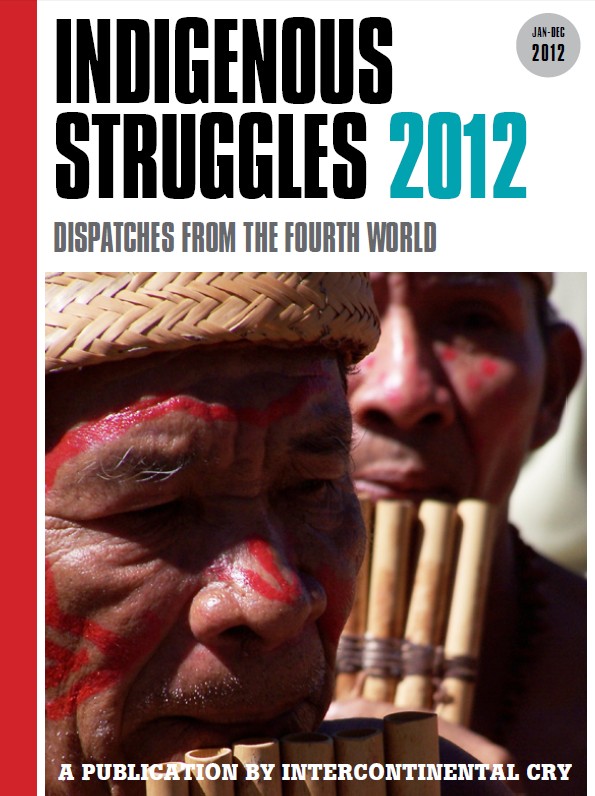
Intercontinental Cry, an independent, volunteer-run magazine dedicated to Indigenous Peoples, has released “Indigenous Struggles 2012: Dispatches from the Fourth World.” The report, which is described as an annual briefing on the global Indigenous movement, is based on Intercontinental Cry’s monthly “Underreported Struggles” reports. 

The introduction marks the monumental advances made by the global Indigenous movement in 2012, noting “the Nasa’s expulsion of military personnel from their territory in Colombia, the group of villagers in India who enforced the destruction of Monsanto test crops, a dozen solid victories against the tar sands and associated pipelines, and let’s not forget the sudden appearance of #idlenomore in Canada and the equally sudden establishment of new Indigenous governments in Nigeria, Australia and West Papua.” It also notes some of the challenges and tragedies of 2012. 

The introduction can be accessed here. The full report can be downloaded directly here. Follow Intercontinental Cry on Twitter here and like them on Facebook here. 
Read More
Posted in Indigenous Peoples Movement, Indigenous Peoples Rights, Intercontinental Cry | No comments

Tuesday, 11 December 2012

Panel on COP 18 and Indigenous Peoples' Rights

Posted on 06:32 by Unknown
Analysis of the Current State of COP18 Negotiations and Indigenous Peoples' Demands on the Green Climate Fund from Tebtebba on Vimeo.

Via the Asia Indigenous Peoples Pact (AIPP), a recent panel offered representatives from Indigenous rights organisations a platform to share their analysis of the climate change negotiations on 4 December 2012 in Doha, Qatar, during the UN Framework Convention on Climate Change’s 18th conference of parties (COP 18). The panel was organised by Tebtebba and the Indigenous Peoples’ Partnership on Climate Change and Forests and panelists included Victoria Tauli-Corpuz (Tebtebba), Dennis Mairena (Centro para la Autonomia y Desarollo de los Pueblos Indigenas - Nicaragua), and Stanley Kimaren (Indigenous Livelihoods Enhancement Partners - Kenya). 

The panelists analysed texts from the Subsidiary Body on Implementation and the Subsidiary Body on Scientific and Technological Advice and noted the extremely slow pace in negotiations in the Long Term Cooperative Action and Kyoto Protocol working groups. They also discussed the importance in protecting gains made by Indigenous peoples in the next climate change agreement, including the recognition of the UN Declaration on the Rights of Indigenous Peoples, recognition of the traditional knowledge of Indigenous peoples, and the requirements for full and effective participation in climate change programmes. On the Green Climate Fund, the panelists called for full and effective participation of Indigenous peoples, with separate representation from civil society.

Also relevant to climate change negotiations, Simone Lovera (Global Forest Coalition) recently drafted an article, posted on REDD-Monitor, on how the form of Measuring, Reporting and Verification (MRV) systems being developed to track the Reducing Emissions from Deforestation and Forest Degradation (REDD+) programme may be a ‘trojan horse’ for carbon markets that have yet to demonstrate results. 

Video from the panel can be accessed here. Simone Lovera’s article can be found here.
Read More
Posted in AIPP, COP 18, Indigenous Peoples Rights, International Advocacy, REDD, SBSTA, UNDRIP, UNFCCC | No comments

Thursday, 29 November 2012

Important Publications on REDD+ for COP 18

Posted on 23:12 by Unknown
As government representatives gather to consider solutions to, and means to mitigate the impact of, climate change at the 18th Conference of Parties of the United Nations Framework Convention on Climate Change, several significant publications on the impact of climate change and Reducing Emissions from Deforestation and Forest Degradation (REDD+) on the rights of Indigenous peoples have been launched by Natural Justice partners. 

The Asia Indigenous Peoples Pact (AIPP) and the International Work Group for Indigenous Affairs (IWGIA) have published a briefing paper entitled "REDD+, Rights and Indigenous Peoples: Lessons from REDD+ Initiatives in Asia." The brief examines how far countries participating in REDD+ in Asia have advanced in addressing the social and environmental safeguards needed for the implementation of REDD+ and reflects on pilot activities in Nepal, Cambodia and Vietnam. Their findings suggest that outstanding critical issues for Indigenous peoples include the lack of effective engagement, free, prior and informed consent, and unresolved land tenure and carbon rights issues. The brief can be downloaded here.  

The Forest Peoples Programme, has released a note that refers to the Indigenous Peoples Caucus position on REDD+ and analyses key issues and opportunities for Indigenous peoples to influence the current REDD+ negotiations in Doha. The note can be downloaded here. 

The Indigenous Peoples Caucus, on behalf of the International Indigenous Peoples Forum on Climate Change (IIPFCC), released a statement to the Subsidiary Body for Scientific and Technical Advice (SBSTA) concerning REDD+ which raised issues such as the need to respect collective and customary systems of forest governance and management, the roles and contributions of Indigenous women, and the need for an independent complaints mechanism. The statement can be accessed here.
Read More
Posted in AIPP, COP 18, Doha, FPP, IIPFCC, Indigenous Peoples Caucus, Indigenous Peoples Rights, IWGIA, REDD+, SBSTA, UNFCCC | No comments

Tuesday, 27 November 2012

AIPP Report on Indigenous Peoples and Climate Change Adaptation

Posted on 23:38 by Unknown
Climate change is increasingly impacting the livelihoods and wellbeing of Indigenous peoples through erratic rainfall, unpredictable climatic patterns, flooding, and increased water and food security. To explore these challenges, consider the ways that Indigenous peoples are responding to them and identify policy options to support Indigenous peoples' climate change adaptation, the Asia Indigenous Peoples Pact (AIPP) has released a report entitled “Indigenous Peoples and Climate Change Adaptation in Asia.” 

The report reviews two case studies on Indigenous adaptation practices. The first, a survey of the Tangkhul Naga of northeast India, notes the significant impact of climate change in the community, including shifts in species of birds, reduced frost in October, increased pests and weeds, and shifting rain patterns. In response, the Tangkhul Naga have adjusted their agricultural practices to emphasise un-burnt shifting cultivation over rain-fed terrace paddies. The report also considers the adaptation practices of the Pidlisan-Kankanaey community of the Philippines. 

The report then summarises key international frameworks relevant to climate change adaptation. It concludes with policy recommendations on Indigenous peoples and climate change adaption, urging greater recognition of Indigenous peoples’ traditional knowledge and community-based adaptation strategies, increased recognition of Indigenous peoples’ rights, ensuring free, prior and informed consent in all mitigation and adaptation programmes, and providing sustainable livelihood diversification support to communities. 

“Indigenous Peoples and Climate Change Adaptation in Asia” can be downloaded here.
Read More
Posted in Adaptation, AIPP, Asia, Climate Change Adaptation, India, Indigenous Peoples Rights, Mitigation, Philippines | No comments

Friday, 23 November 2012

Fellowship Opportunity at IACHR

Posted on 08:14 by Unknown
Natural Justice strongly encourages partners to consider applying for a recently opened fellowship on Indigenous peoples' rights with the Executive Secretariat of the Inter-American Commission on Human Rights (IACHR) of the Organisation of American States (OAS). The IACHR has been a leading institution for the advancement of Indigenous peoples' rights, and fellows will support the Rapporteurship on the Rights of Indigenous Peoples. The position has been opened to provide an opportunity for young lawyers from OAS Member States to understand and apply the mechanisms of protection of the inter-American system of human rights in the area of Indigenous peoples’ rights. 

Successful applicants must be citizens of an OAS member state, be proficient in Spanish, have received a law degree after January 2005, and have a demonstrable professional interest in the legal field of human rights, specifically in the area of Indigenous peoples’ rights. Applicants must present a paper of up to five pages, not edited by another person, on a human rights issue of interest to the candidate in the area of indigenous peoples’ rights. 

Find out more about the position here.
Read More
Posted in Human Rights, IACHR, Indigenous Peoples Rights, Inter-America, OAS | No comments

Article on Unique Rights of Indigenous Peoples - Think Africa Press

Posted on 06:04 by Unknown
Via thinkafricapress.com
The body of law and policy around the rights of Indigenous peoples and local communities is changing and expanding rapidly. To offer a brief overview of notable international instruments and cases relevant to the African context, Dinah Shelton of the Inter-American Human Rights Commission has prepared an article on relevant law entitled "The Unique Rights of Indigenous Peoples" for a Think Africa Press online course on ‘International Law and Africa.’ 

The article briefly explains and considers the implications of developments in three areas: the international sphere; African cases; and Inter-American cases. At the international level, ILO Convention No. 107, ILO Convention No. 169, and the UN Declaration on the Rights of Indigenous Peoples are considered. For African cases, the Endorois case at the African Commission on Human and Peoples Rights is covered. On Inter-American cases, the growing jurisprudence around land rights and the right to property, as well as the Awas Tingni judgment of the Inter-American Court, are detailed. 

The article can be accessed here. More information on the Think Africa Press course, which is offered free of charge, can be found here.
Read More
Posted in ACHPR, Africa, E-Learning, Education, Endorois Case, IACHR, ILO, Indigenous Peoples Rights, Online Eduction, UNDRIP | No comments

Monday, 19 November 2012

Two Opportunities for EMRIP Submissions

Posted on 07:41 by Unknown
Via www.ohchr.org
Two significant opportunities are available to contribute to the Expert Mechanism on the Rights of Indigenous Peoples' (EMRIP) work to develop and monitor the implementation of law and policy around Indigenous people’s rights. The first is a survey for Indigenous peoples on strategies for implementing the United Nations Declaration on the Rights of Indigenous Peoples (UNDRIP). The survey can be completed online here and should be submitted by 18 February, 2013. 

The second is an opening for contributions by Indigenous peoples, academia, national human rights institutions, civil society and other interested groups and persons  on EMRIP's study on access to justice in the promotion and protection of Indigenous peoples’ rights. There is no prescribed form for submissions, and contributions should submitted via email to expertmechanism@ohchr.org by 11 Febrary, 2013.
Read More
Posted in Access to Justice, EMRIP, Indigenous Peoples Rights, Legal Submissions, UN, UNDRIP | No comments

Friday, 16 November 2012

1st Africa Land Forum - Yaoundé Declaration

Posted on 08:00 by Unknown
In recent years, the demand for productive land has surged as a result of global food and financial crises, as well as increasing concerns about energy security. In many countries, carbon sequestration as a response to climate change has also contributed to land pressure. This has rendered land an increasingly disputed and commoditised resource, compromising rural people’s access to, and control over, land. Indigenous communities have been particularly vulnerable to these pressures as many in Africa are pastoralists and hunter-gatherers and the land they occupy and depend on for their livelihoods is often perceived as empty. 

In this context, the First Africa Land Forum, themed “Securing the land rights of indigenous people and rural communities,” was held in Yaoundé, Cameroon from 7-8 November, 2012. The forum was organised by the Africa Platform of the International Land Coalition (ILC) and hosted by the Mbororo Social and Cultural Development Association (MBOSCUDA). Over 95 participants from 22 countries, representing indigenous and non-indigenous organisations, attended. The forum culminated in the drafting and signing of the Yaoundé Declaration. 

The declaration identifies many challenges and issues emerging in the African context. The land rights of women are still limited by existing African patriarchal systems. Laws and policies often fail to recognise and protect the land rights of indigenous and minority populations. Land tenure is under pressure as a result of population growth and climate change. Low literacy on land laws by citizens, a lack of land laws published in local languages, and complex land administration systems make it difficult for many to secure their land rights. The commodification and privatisation of land has led to conflict and has undermined customary land tenure systems. In addition, the creation of national parks and protected areas continues to displace marginalised populations. 

The declaration seeks to address these challenges by encouraging sustainable and equitable land governance systems; the registration of collective rights over the commons, including grazing lands; wider participation in decision-making over land; the harmonisation of customary law and legislation so that women and men have equal rights to control and own land and natural resources; recognition for small-scale producers in the development of national strategies for food security and rural development; and fair and accessible land conflict resolution mechanisms, particularly where land and natural resources are shared by indigenous peoples and others. 

Read more about the forum here. The Yaoundé Declaration can be downloaded in French here and in English here.
Read More
Posted in Africa, Indigenous Peoples Rights, Land Tenure Security | No comments

Thursday, 8 November 2012

Major New Partnership - National Khoi-San Council and Natural Justice

Posted on 02:58 by Unknown

NKC Chairperson Cecil Le Fleur
signing the MoU
Natural Justice has established a ground-breaking relationship with South Africa’s National Khoi-San Council (NKC), the government-convened body of representatives from Khoe and San communities of South Africa. Natural Justice’s Lesle Jansen, Laureen Manuel and Johan Lorenzen presented Natural Justice’s proposed partnership with the NKC, which the Open Society Initiative of Southern Africa (OSISA) has agreed to support, to the Council from 6-7 November, 2012, in Bloemfontein, South Africa. A memorandum of understanding committing both parties to the completion of the proposed activities was signed between Natural Justice and NKC on November 7, 2012.  

Natural Justice will support NKC to achieve three objectives through the partnership:
  • Support the Council in having meaningful consultations amongst Council communities, members and with government;
  • Engage in legal training for the NKC around the National Traditional Affairs Bill and its continued negotiations;
  • Consult with Khoe and San communities to draft a self-governance model based on the human rights issues set out in the UN Mission report recommendations of 2005. 

The initial partnership is for 12 months but it is hoped that this will be the foundation of an enduring relationship. 
Read More
Posted in bio-cultural community protocols, Community Protocols, Indigenous Peoples Rights, Khoe, NKC, OSISA, Our Work, San, South Africa | No comments

Monday, 5 November 2012

Critical REDD Documentary from The Mending News

Posted on 04:57 by Unknown

The Mending News, a news source that seeks to 'mend' current issues, has released a scathing critique of Reducing Emissions from Deforestation and Forest Degradation (REDD) entitled "Exposing REDD: The False Climate Solution.” The documentary seeks to highlight the risk that REDD will not reduce deforestation and will merely enable more pollution while decreasing the land tenure security of communities in the 'global south', especially Indigenous communities. 

The documentary includes an interview with Tom Goldtooth of the Indigenous Environmental Network. Mr Goldtooth argues in the film that the issue with carbon trading is that "(b)efore you can trade anything, and treat anything as a commodity, you have to determine who owns that. So who owns the carbon, the air, whether it’s in the trees, in the soil, in the plants, in the air? Whose property right is that? As Indigenous Peoples you know we, many of us embrace the cosmo-vision, the spirituality, the sacred relationship that we hold dear to who we are, especially our relationship to the sacredness of Mother Earth."

The film can be accessed here. A transcript of the film can be found here. Natural Justice is currently exploring with a range of partners how to ensure the REDD-related funds and mechanisms can support Indigenous peoples' and local communities' ongoing efforts to protect and conserve their forests according to their own terms, plans and priorities. Natural Justice's e-module for communities potentially affected by REDD can be accessed here. 
Read More
Posted in IEN, Indigenous Peoples Rights, REDD | No comments

Thursday, 25 October 2012

UNGA Report on Status of Indigenous Children's Rights

Posted on 04:59 by Unknown
Via www.unicef.org
The UN Secretary-General has submitted a report on the implementation of the Convention on the Rights of the Child, which was adopted in 1989 and has been ratified or acceded to by 193 states, to the  UN General Assembly. The report focuses on the rights of indigenous children, and finds that indigenous children suffer extreme forms of exclusion and discrimination, stating that "children of indigenous background often suffer within schools and communities from various forms of abuse rooted in discrimination and discriminatory attitudes."

It also finds, encouragingly, that "the creation and strengthening of indigenous peoples’ organizations, and the establishment of United Nations bodies and structures such as the Permanent Forum on Indigenous Issues and the Expert Mechanism on the Rights of Indigenous Peoples; and the various special procedures of the Human Rights Council and the African Commission on Human and Peoples’ Rights, as well as progressive developments in the jurisprudence of the Inter-American system of human rights, are offering unique opportunities to bring issues affecting indigenous children to the forefront of national, regional and global agendas."

The report concludes with recommendations for the way forward, including adopting measures to prevent and eliminate all forms of discrimination against indigenous children; facilitating the active participation of indigenous peoples in all stages of development planning affecting them; undertaking special measures towards the realization of the right to education of indigenous children, particularly girls; and taking special measures to promote the highest attainable standard of health and health-care services for indigenous children.

The report can be found here. 
Read More
Posted in Childrens Rights, Indigenous Peoples Rights, UN, UNGA | No comments

Sunday, 21 October 2012

Overview of Key CBD COP11 Outcomes

Posted on 23:27 by Unknown
Kabir Bavikatte (left) and Holly Shrumm (Natural Justice)
discussing key issues in the negotiations towards a plan
of action on customary sustainable use. Photo via IISD-RS.
Natural Justice was recently in India for the 11th Conference of the Parties (COP11) to the Convention on Biological Diversity (CBD), which took place from 8-19 October in Hyderabad. In addition to a range of events and meetings, we actively participated in the negotiations, with particular emphasis on the draft decisions on Article 8(j) and Related Provisions, Sustainable Use of Biodiversity, and Protected Areas. Other key agenda items for which we provided technical guidance and coordination assistance through the CBD Alliance and ICCA Consortium included: Monitoring Progress on the Implementation of the Strategic Plan and Aichi Biodiversity Targets; Review of the Programme of Work on Island Biodiversity; Ecosystem Restoration; Marine and Coastal Biodiversity; Biodiversity and Climate Change; Biodiversity for Poverty Eradication and Development; Biological Diversity of Inland Water Ecosystems; Forest Biodiversity; and Agricultural Biodiversity.

The overriding emphasis of the negotiations was on setting the foundations for resource mobilisation and policy alignment for implementation of the 2011-2020 Strategic Plan and Aichi Biodiversity Targets. Amongst the 33 decisions adopted, there were many provisions of direct relevance to the work of Natural Justice and our partners.
A selection of relevant provisions include (in numerical order):
  • Decision XI/1 (Status of the Nagoya Protocol on Access and Benefit Sharing): Parties to undertake and provide support for capacity building initiatives, including participation of Indigenous peoples and local communities in legal, policy and decision-making processes, and the development of community protocols;
  • Decision XI/2 (Review of Progress in Implementation of National Biodiversity Strategies and Action Plans): Parties to include all stakeholders, including Indigenous peoples and local communities, in planning and implementing national biodiversity strategies and action plans;
  • Decision XI/7 (Business and Biodiversity): Parties to help businesses assess and effectively address their impacts on biodiversity and on Indigenous peoples and local communities;
  • Decision XI/14 (Article 8(j) and Related Provisions): under the section on progress in implementation, Parties to include in requests to the Global Environment Facility and Small Grants Programme and other donors support for Indigenous peoples and local communities to organise themselves, to develop community plans and protocols, to document, map and register their ICCAs, and to prepare and implement their community conservation plans; and to provide support to countries to strengthen recognition of ICCAs; 
  • Decision XI/14 (Article 8(j) and Related Provisions): under the section on Article 10 and 10(c) as a major component of the programme of work, Parties decided that the three initial tasks for the new work on Article 10 and 10(c) are to incorporate customary sustainable use practices or policy into national biodiversity strategies and action plans; to promote and strengthen community-based initiatives; and to identify best practices to promote the full and effective participation of Indigenous peoples and local communities in the establishment, expansion, governance, and management of protected areas, to encourage the application of traditional knowledge and customary sustainable use in protected areas, and to promote the use of community protocols to affirm and promote customary sustainable use in protected areas;
  • Decision XI/14 (Article 8(j) and Related Provisions): under the section on recommendations from the Permanent Forum on Indigenous Issues, Parties to further consider adopting the phrase "indigenous peoples and local communities" (instead of "indigenous and local communities") at the next Working Group on Article 8(j) and at COP12 in 2014;
  • Decision XI/16 (Ecosystem Restoration): Parties to promote the full and effective participation of Indigenous peoples and local communities and the use of traditional knowledge and practices in appropriate ecosystem restoration activities;
  • Decision XI/17 (Marine and Coastal Biodiversity: EBSAs): Parties to also use traditional knowledge and social and cultural information to help describe and identify ecologically or biologically significant marine areas;
  • Decision XI/21 (Other Matters Related to Biodiversity and Climate Change): Parties to take into account traditional knowledge, innovations and practices when addressing the impacts of climate change;
  • Decision XI/22 (Biodiversity for Poverty Eradication and Development): Parties to protect and encourage the customary use of biological resources and to promote biodiversity and development projects that empower women and Indigenous peoples and local communities; an Expert Group on the same topic will, among other things, develop a conceptual framework and guidance on how to assess the role of collective action and the efforts of Indigenous peoples and local communities in conservation, stewardship, and sustainable management of biodiversity and natural renewable resources, including exploring the role of non-market-based approaches;
  • Decision XI/24 (Protected Areas): Parties to strengthen recognition of and support for community-based approaches to in situ conservation and sustainable use, including Indigenous peoples' and community conserved territories and areas (ICCAs), and support the development of local and international registries of ICCAs; to direct benefits arising from the use of genetic resources to enhance management and establishment of protected areas and share benefits with Indigenous peoples and local communities; and
  • Decision XI/25 (Sustainable Use): Parties to build and strengthen capacities of Indigenous peoples and local communities to exercise rights and responsibilities to sustainably manage wildlife resources.

Further Information

The advance unedited version of all COP11 decisions is now available online. Daily coverage and a detailed summary report of the negotiations are available online courtesy of the International Institute for Sustainable Development Reporting Services (IISD-RS). The CBD Alliance and CBD Secretariat published the latest issue of their joint newsletter, [square brackets], for the beginning of COP11 and the issues remain relevant.
Read More
Posted in Aichi Biodiversity Targets, Article 8j, biocultural community protocols, CBD, COP 11, Customary Sustainable Use, ICCAs, Indigenous Peoples Rights, Local Communities, Protected Areas, Traditional Knowledge | No comments

Sunday, 14 October 2012

CBD Secretariat Hosts Colloquium on ICCAs and Aichi Targets

Posted on 07:38 by Unknown
Participants of national conference on ICCAs in the 
Philippines, which took place in March 2012. Photo via
iccaforum.org.
According to a notification of the Secretariat of the Convention on Biological Diversity (CBD), Indigenous peoples’ and local community conserved territories and areas (ICCAs) provide multiple ecological, cultural and biodiversity values, contribute greatly to food and water security and other ecosystem processes, and help achieve the Strategic Plan for Biodiversity 2011-2020 and Aichi Biodiversity Targets. ICCAs play a critical role in ensuring access and respecting rights to customary sustainable use and facilitating inter-generational communication of traditional environmental knowledge, innovations and practices. The Secretariat continues by noting that ICCAs are increasingly recognised as the living embodiment of both Articles 8(j) and 10(c) of the CBD.

In an effort to support implementation of these Articles and several past CBD decisions, on 13 October at the 11th Conference of the Parties to the Convention on Biological Diversity (CBD COP11), the CBD Secretariat co-hosted a one-day colloquium on the role of ICCAs in achieving the 2011-2020 Aichi Biodiversity Targets, along with the governments of Brazil, India, Mexico, the Philippines, Senegal, and South Africa, the ICCA Consortium, the International Indigenous Forum on Biodiversity, and Conservation International.

The colloquium was opened by the Deccan Development Society and several Dalit farmers, who gave a spiritual blessing and spoke about the challenges they have faced on the road to securing food sovereignty. Opening remarks were given by the following esteemed speakers: Braulio Ferreira de Souza Dias (Executive Secretary, CBD); Delfin Ganapin (Global Coordinator, GEF Small Grants Programme); Russell Mittermeier (President, Conservation International); Taghi Farvar (President, ICCA Consortium); and Trevor Sandwith (Director, IUCN Global Protected Areas Programme). Following a presentation by John Scott and Sarat Gidda (CBD Secretariat) on the linkages between ICCAs and global policy, Ashish Kothari (Kalpavriksh) gave a keynote address on a global study compiled by the ICCA Consortium, Kalpavriksh, Natural Justice, and IUCN-TILCEPA on legal and non-legal forms of recognition and support for ICCAs. The study was published as Technical Series Volume 64 by the CBD Secretariat. (A complementary global study coordinated by Natural Justice and Kalpavriksh on behalf of the ICCA Consortium focused in more depth on legal and institutional aspects of recognizing and supporting ICCAs and is available online.)

The rest of the colloquium consisted of three engaging panels that highlighted experiences and lessons learned from Asia-Pacific, Africa, and Latin America and the Caribbean. Each panel was chaired by a government representative from the respective region and included presentations by Indigenous peoples, NGOs, and governments.

The CBD Secretariat's official notification of the colloquium and the day's programme can be viewed here.  A summary report is available here. More information about the ICCA Consortium's engagement in COP11 can be found here.
Read More
Posted in Aichi Biodiversity Targets, CBD, COP11, ICCAs, Indigenous Peoples Rights, Legal Review, Local Communities, Our Work | No comments

Friday, 12 October 2012

Workshop on National Federations and Coalitions of ICCAs

Posted on 07:11 by Unknown
Jorge Nahuel (Mapuche Tribe, Argentina) speaking about a
tri-national coalition of Indigenous peoples. Photo credit: 
Aurelie Neumann / ICCA Consortium.
On 11 October at the 11th Conference of the Parties to the Convention on Biological Diversity (CBD COP11), the ICCA Consortium, Global Environment Facility Small Grants Programme (GEF-SGP), and many local partners co-hosted a 3-hour workshop entitled “National ICCA Federations and Coalitions Ready to Take Conservation Authority and Responsibilities Towards Fulfilling the Aichi Biodiversity Targets”. The workshop shared experiences of a range of federations and coalitions of Indigenous peoples’ and community conserved territories and areas (ICCAs) from around the world, including the Philippines, Madagascar, Nepal, India, Iran, and Argentina. Additional reflections were provided by representatives from GEF-SGP, Australia, Pakistan, Taiwan, the Democratic Republic of Congo, and the Philippines.

Particular emphasis was placed on how federations, coalitions and related social movements are being mobilised at all levels to secure Indigenous peoples' and local communities' rights, customary territories, and ways of life. Delfin Ganapin (GEF-SGP) reminded workshop participants that because federations have the potential to challenge the political status quo, the stronger the social movements become, the more resistance they will likely face from governments and industries in power. In the words of Dave de Vera (Philippine Association for Intercultural Development), despite significant legal and policy gains, "There is still so much to be done; the struggle will always continue."

More information about the ICCA Consortium's engagement in CBD COP11 is available here.
Read More
Posted in CBD, COP11, ICCAs, Indigenous Peoples Rights, Local Communities | No comments

Thursday, 11 October 2012

OPDP Seeking Interns in Kenya

Posted on 00:50 by Unknown

Via www.ogiekpeoples.org
Natural Justice partner the Ogiek Peoples' Development Program (OPDP) is seeking two interns to support their work in their Nakuru, Kenya office. OPDP seeks to "provide a springboard from which Ogiek community," a marginalised indigenous community in western Kenya, "can take a lead role in articulating and advancing their developments, aspirations, priorities and social needs." The positions, one focused on human rights and the other on website design and development, will be for a minimum of eight weeks. The positions are currently unfunded but OPDP can work with prospective interns to source funding support. Accommodation will be provided by OPDP. 

Read more about the positions below. 

Ogiek Peoples’ Development Program (OPDP) - Nakuru, Kenya
Internship Position Opening (2 persons) – 

(i) Human Rights
(ii) Website Designer and developer

The Ogiek Peoples’ Development Program is currently accepting applications for the position of Human Rights Intern and Website designer & Developer. This position is available to Kenyan and non-Kenyan undergraduate or Postgraduate students who have demonstrated experience in human rights or in the field of Information systems or website designing and development. This is an unfunded positions but OPDP will work with prospective interns to assist them to apply for funding support.

About OPDP:
The Ogiek Peoples’ Development Program (OPDP) was founded in 1999, and registered as a Non-Governmental Organization (NGO) in 2001 by the Kenyan government. OPDP is dedicated to serving the interests of the Ogiek people of Kenya, who are the indigenous inhabitants of Kenya’s last remaining rain forest, the Mau Forest and Mt.Elgon Forest. Key issues that the Ogiek face include marginalization amongst ethnic communities in Kenya, loss of culture and group identity, forced evictions, violence against women, land grabbing, environmental degradation, and ongoing economic, social and cultural violations. The Ogiek currently are litigating their rights at the African Court of Human and Peoples Rights, only the second case to be referred from the African Commission to the African Court. OPDP works with networks of indigenous advocates and human rights defenders across Kenya, Africa, and the globe to raise awareness of Ogiek issues and to bring real benefits to the Ogiek people. You can learn more about the Ogiek at www.ogiek.org and www.ogiekpeoples.org.

Intern Duties
1. Human Rights and Indigenous Peoples
  • Assist with human rights monitoring and documentation projects related to the rights of indigenous peoples
  • Writing and editing human rights reports, advocacy briefs, and other publications
  • International human rights research
  • Research on Kenyan and African regional human rights standards
  • Develop on-line content
  • Participate in other projects as assigned by the Executive Director  or  Programmes Officer


2. Website  designer and  developer
  • Assist in reviewing our current website
  • Work closely with our administrator in uploading documents to the website
  • Develop an E-newsletter
  • Develop a portal for OPDP by working closely with OPDP  administrator to ensure future continuity
  • Participate in other projects as assigned by the Executive Director  or  Programmes Officer

Note
An intern who has both the experience will have an added advantage. OPDP will provide accommodation for the period of internship, which does not include food. We will also provide transport when going to the field as per OPDP policies.

Duration:
Interns must commit to a minimum of eight weeks commitment to work with OPDP.

Application:
Send a cover letter and resume or CV to OPDP, via opdp2001@yahoo.com or opdp@ogiekpeoples.org. Please describe why you are interested in working with an indigenous peoples’ organization in Africa, your experience in human rights work, how you will fund your expenses during the internship period, as well as any other relevant information to help us evaluate your application. 
Read More
Posted in ACHPR, Africa, Community Protocols, Indigenous Peoples Rights, Kenya | No comments
Older Posts Home
Subscribe to: Posts (Atom)

Popular Posts

  • Warsaw Climate Change Conference
    The 19th session of the Conference of the Parties to the United Nations Framework Convention on Climate Change takes place in Warsaw, Poland...
  • ICCA meeting for Southern and East Africa discusses ICCA examples from the region
    On 8 November Natural Justice and the ICCA Consortium co-convened a meeting near Cape Town, South Africa, on Indigenous Peoples and Local ...
  • New Research Questions Effectiveness of RSPO Standards
    "Members of the Roundtable on Sustainable Palm Oil ( RSPO ) are violating the rights of indigenous peoples and local communities in the...
  • Substantive and Procedural Injustices of the Nagoya Protocol
    A Joint Submission of the Grand Council of the Crees (Eeyou Istchee), endorsed by 73 organizations globally (and counting), comprehensively ...
  • Imbak Canyon Ethno-forestry
    Harry Jonas of Natural Justice presented on "ABS: From International Law to Local Realities" at a workshop hosted by Yayasan Sab...
  • United Nations Permanent Forum on Indigenous Issues Enters Second Week
    The twelfth session of the United Nations Permanent Forum on Indigenous Issues (UNPFII) is currently taking place at United Nations headqu...
  • Second edition of The Living Convention is now available in English and Spanish
    The Living Convention provides a range of the most important provisions relating to the linkages between Indigenous peoples and local commu...
  • International Workshop on ICCAs in Thika, Kenya
    On November 5th 2013, Maya Sikand from Natural Justice attended and presented at an International Workshop on ICCAs in Thika, Kenya. The wor...
  • Africa Regional Symposium for Community Land and Natural Resources Protection
    From 5-7 November, 30 pioneering community and civil society experts gathered in the !khwa ttu San community centre outside Cape Town, South...
  • South-South Exchange Mechanism
    On Thursday October 31st Maya Sikand of Natural Justice attended a meeting of the South-South Exchange Mechanism at the Global South-South ...

Categories

  • Aarhus Convention
  • ABS
  • ABS Capacity Development
  • ABS Capacity Development Initiative
  • ABS Focal Points
  • ABS Initiative
  • ABS Intiative
  • ABS Legislation
  • ABS Regulations
  • access and benefit sharing
  • Access to Justice
  • Accountability
  • ACHPR
  • Adaptation
  • Africa
  • African BCP
  • African Biodiversity Network
  • African Caucus
  • African Court on Human and People's Rights
  • African Group
  • African Union Commission
  • agricultural investments
  • Agriculture
  • Aichi Biodiversity Targets
  • AICHR
  • AIPP
  • ALDAW
  • ALF
  • Alien Tort Statute
  • Amazon
  • ARI-BCP
  • ARI-BCPs
  • Article 8j
  • Artisanal Fishing
  • ASEAN
  • Ashoka Fellowship
  • Asia
  • AU
  • Australia
  • BCP
  • BCP Initiative
  • BCP Toolkit
  • BCPs
  • BCRs
  • Benefit sharing
  • Berne Declaration
  • Bhutan
  • bio-cultural community protocols
  • biocultural community protocols
  • Biocultural Dialogues
  • Biocultural Diversity
  • Biocultural Rights
  • Biodiversity
  • Biodiversity Conservation
  • Biofuels
  • BIOPAMA
  • Biopiracy
  • bioprospecting
  • Biotrade
  • Borana
  • Borneo Conservancy Initiative
  • Borneo Eco Film Festival
  • Brazil
  • Bushbuckridge
  • Business
  • Business and Human Rights
  • Cambodia
  • CAO
  • Capacity Development
  • Carol Rose
  • CBD
  • CBD Alliance
  • CBNRM
  • CCPCJ
  • CEDAW
  • CFR
  • Childrens Rights
  • Chinese Ministry of Commerce
  • CIFOR
  • CIKOD
  • Climate change
  • Climate Change Adaptation
  • Commons
  • Communications
  • Community Empowerment
  • community film-making
  • community forest resources
  • Community Governance
  • Community Land Rights
  • Community Protocols
  • community resource rights
  • Community Rights
  • community-based conservation
  • conflict prevention
  • Conservation
  • Conservation Governanace
  • Consultation
  • Convention on Biological Diversity
  • Convention to Combat Desertification
  • COP 11
  • COP 18
  • COP11
  • corporate liability
  • Costa Rica
  • CSR
  • Customary Justice
  • Customary Sustainable Use
  • Design
  • Development
  • development aggression
  • Dialogue
  • Documentation
  • Doha
  • DRC
  • Dusun
  • E-Learning
  • ECCHR
  • ECO
  • Economic Growth
  • Ecosystem Services
  • Ecuador
  • Education
  • Employment
  • EMRIP
  • Endorois Case
  • Energy
  • ENVI
  • Environmental Impact Assessment
  • Environmental Law
  • environmental protection
  • ESPA
  • ETC COMPAS
  • EU
  • Eviction
  • Extractive Industries
  • FAO
  • Farmers' Rights
  • FCPF
  • Finance
  • Financial Sector
  • First Peoples
  • Food Security
  • Ford Foundation
  • Foreign Investment and Cooperation
  • Forest Carbon Partnership Facility
  • Forest Peoples' Rights
  • Forest Rights Act
  • Forestry Resources
  • Forests
  • Forever Sabah
  • FPIC
  • FPP
  • FRA
  • Fracking
  • Francais
  • Friedrich Ebert Stifung
  • Gaia Foundation
  • GCF
  • GDF
  • GEF
  • Gender
  • Genetic Resources
  • GEO
  • GESA
  • Ghana
  • Global Canopy Programme
  • Global Environmental Institute
  • Global Forest Coalition
  • GM
  • GNHRE
  • GPS
  • Green Economy
  • Grievance Mechanisms
  • Growing Forest Partnership Initiative
  • GTCR
  • Gujjar
  • Guyana
  • Harry Jonas
  • Heart of Borneo
  • Heinrich Boell
  • Heritage
  • Heritage Parks
  • Himachal Pradesh
  • Honduras
  • Hoodia
  • Human and Environmental Rights monitoring
  • Human Rights
  • Human Rights Council
  • Hutan
  • IACHR
  • IASS
  • ICCA Consortium
  • ICCAs
  • ICMM
  • ICNP
  • IDLO
  • IEN
  • IFC
  • IFIs
  • IIED
  • IIPFCC
  • IISD
  • ILCF
  • ILO
  • Independent Accountability Mechanisms
  • India
  • indigenous
  • indigenous and traditional knowledge
  • Indigenous Information Network
  • Indigenous Knowledge Systems
  • Indigenous Livestock Breeds
  • Indigenous Peoples
  • Indigenous Peoples Caucus
  • Indigenous Peoples Movement
  • Indigenous Peoples Rights
  • Indigenous Peoples' Rights
  • Indonesia
  • Infrastructure
  • Institute of Marine & Environmental Law
  • Intellectual Property
  • Inter-America
  • Intercontinental Cry
  • International
  • International Advocacy
  • International Council on Mining and Metals
  • International Journal of the Commons
  • International Land Coalition
  • IPACC
  • IPBES
  • IPR
  • IPRs
  • IUCN
  • IUCN WCC
  • IWGIA
  • James Anaya
  • JOAS
  • judgement
  • Just Conservation
  • Justice
  • Karoo
  • Katiba Institute
  • Kenya
  • Kenyan National Land Commission
  • Khoe
  • Khoikhoi
  • KhwaTtu
  • Kinabalu Park
  • KIRDTI
  • Kivulini Trust
  • Knowledge sharing
  • KRAPAVIS
  • Kukula
  • Kyoto Protocol
  • Lamu
  • Land Grabbing
  • Land investments
  • Land Matrix Project
  • Land Tenure Security
  • Land Title
  • LAPPSET
  • LAPSSET
  • Latin America
  • LEAP
  • LED
  • Legal Aid
  • Legal Empowerment
  • Legal ngo
  • Legal Research
  • Legal Review
  • Legal Submissions
  • Livelihoods
  • Livestock keepers
  • Livestock Keepers' Rights
  • Living Convention
  • Local Communities
  • Locally Controlled Forestry
  • low-cost solutions
  • LPP
  • LPPS
  • Madagascar
  • Major Infrastructure
  • Malaysia
  • Maldhari
  • Maliasili Initiatives
  • Manu National Park
  • manual
  • Maori
  • MAT
  • Mau Forest
  • Messaging
  • Mexico
  • Millennium Development Goals
  • Mining
  • Ministry of Environmental Protection
  • Minority Rights
  • Mitigation
  • Mokgola community
  • Mozambique
  • MSP
  • Multistakeholder Processes
  • Nagoya Protocol
  • Nahuru
  • Nama
  • Namati
  • Namibia
  • National Environmental Management
  • National Geographic
  • Natural Capital
  • natural resources
  • NBSAPs
  • New York
  • New Zealand
  • NKC
  • Norton Rose Fullbright
  • NRM
  • OAS
  • Ocean Grabbing
  • Oceania
  • Odisha
  • OECD
  • Ogiek Community
  • Online Eduction
  • Open Society Foundation in Southern Africa
  • OSISA
  • Ostrom
  • Our Work
  • Oxfam
  • Pacific Region
  • PACOS
  • Palawan
  • Palm Oil
  • Pan-African Workshop
  • Paraguay
  • Participatory Mapping
  • participatory video
  • Pastoralist
  • Pastoralist Rights
  • Peru
  • Philippines
  • Photography
  • phyto-trade
  • PIC
  • Platinum mining
  • pollinators
  • post-2015 agenda
  • Poverty
  • Programme of Work on Protected Areas
  • Protected Areas
  • Publications
  • PULP
  • Puppet theatre
  • Rachel Carson Center
  • Raika
  • Rainforest Foundation Norway
  • Ramsar
  • REDD
  • REDD+
  • Research
  • Resilience
  • resource curse
  • Resource Rights
  • Rio +20
  • ROAPE
  • Rooibos
  • RRI
  • RSPO
  • Sabah
  • Sacred Natural Sites
  • Sacred Sites
  • Safeguards
  • Samburu
  • San
  • Sariska Tiger Reserve
  • Save Lamu
  • Sawit Watch
  • SBI
  • SBSTA
  • SBSTTA
  • Scientific Consensus Statement
  • SEI
  • Self-determination
  • SGP
  • Small-Scale Fishing
  • SNS
  • Soil
  • SOMO
  • South Africa
  • South-South Exchange Mechanism
  • Southeast Asia
  • Southern Africa
  • spatial planning
  • Special Rapporteur
  • Srishti
  • State Department of Tribal Development & Forests
  • stewardship rights
  • Strategic Litigation
  • SUARA
  • SUHAKAM
  • Sustainability
  • Sustainable Agriculture
  • Sustainable Development
  • Sustainable Development Goals
  • SWOP
  • Tana River Delta
  • Tanchara
  • Tanzania
  • Target 11
  • TCEs
  • TCF
  • tenure
  • The Christensen Fund
  • The Commons
  • The Right to Responsibility
  • TK
  • TK Commons
  • Toolkit
  • Traditional Healers
  • Traditional Justice
  • Traditional Knowledge
  • Transnational litigation
  • Transparency
  • Treasure the Karoo Action Group
  • TRRs
  • UEBT
  • UN
  • UN Declaration on the Rights of Indigenous Peoples
  • UN Global Compact
  • UN Guiding Principles
  • UN Human Rights System
  • UN working group on Human rights
  • UN-REDD
  • UNDP
  • UNDRIP
  • UNEP
  • UNESCO Biosphere Reserve
  • UNFCCC
  • UNGA
  • UNHRS
  • United Nations Permanent Forum on Indigenous Issues
  • United States
  • UNPFII
  • UNU-IAS
  • US Secretary of the Treasury
  • Vanuatu
  • Venezuela
  • Vidarbha LIvelihood Forum
  • Vidarva
  • Video
  • Voluntary Principles
  • Volunteer
  • WCMC
  • Wetlands
  • Wild 10
  • wildlife protection amendment bill 2013
  • WIPO
  • women
  • Women's Rights
  • Working Group on HR and TNCs
  • World Bank
  • World Indigenous Network Conference
  • World Wilderness Congress
  • WWF
  • ZAMI
  • ZCC
  • ZELA

Blog Archive

  • ▼  2013 (198)
    • ▼  November (10)
      • Warsaw Climate Change Conference
      • Heart of Borneo and Forever Sabah
      • ICCA meeting for Southern and East Africa discusse...
      • New Research Questions Effectiveness of RSPO Stand...
      • Africa Regional Symposium for Community Land and N...
      • National Conference on Indigenous Peoples' Land Ri...
      • International Workshop on ICCAs in Thika, Kenya
      • First Peoples release Indigenous Rights Risk Report
      • South-South Exchange Mechanism
      • Natural Justice Attends Side Event During UN GA on...
    • ►  October (20)
    • ►  September (18)
    • ►  August (9)
    • ►  July (14)
    • ►  June (16)
    • ►  May (20)
    • ►  April (22)
    • ►  March (29)
    • ►  February (20)
    • ►  January (20)
  • ►  2012 (221)
    • ►  December (8)
    • ►  November (35)
    • ►  October (29)
    • ►  September (21)
    • ►  August (23)
    • ►  July (18)
    • ►  June (15)
    • ►  May (22)
    • ►  April (13)
    • ►  March (11)
    • ►  February (15)
    • ►  January (11)
  • ►  2011 (88)
    • ►  December (8)
    • ►  November (6)
    • ►  October (13)
    • ►  September (10)
    • ►  August (11)
    • ►  July (13)
    • ►  June (14)
    • ►  May (10)
    • ►  April (3)
Powered by Blogger.

About Me

Unknown
View my complete profile